
AI agent chat
Northplane ships an AI agent that can read and — with human approval — operate your monitoring through the same tools the REST API exposes. The agent is a privilege-less client: every tool call is checked against the calling user’s permissions, mutating actions ride an approval queue, and everything is audited. The language model comes from a provider you connect (Anthropic, OpenAI, Google, a local Ollama, …); Northplane never ships a model and never sends data anywhere until you configure a provider.
The three surfaces
Section titled “The three surfaces”
| Surface | Where | Model comes from | Persisted as | Needs server-level ai.provider? |
|---|---|---|---|---|
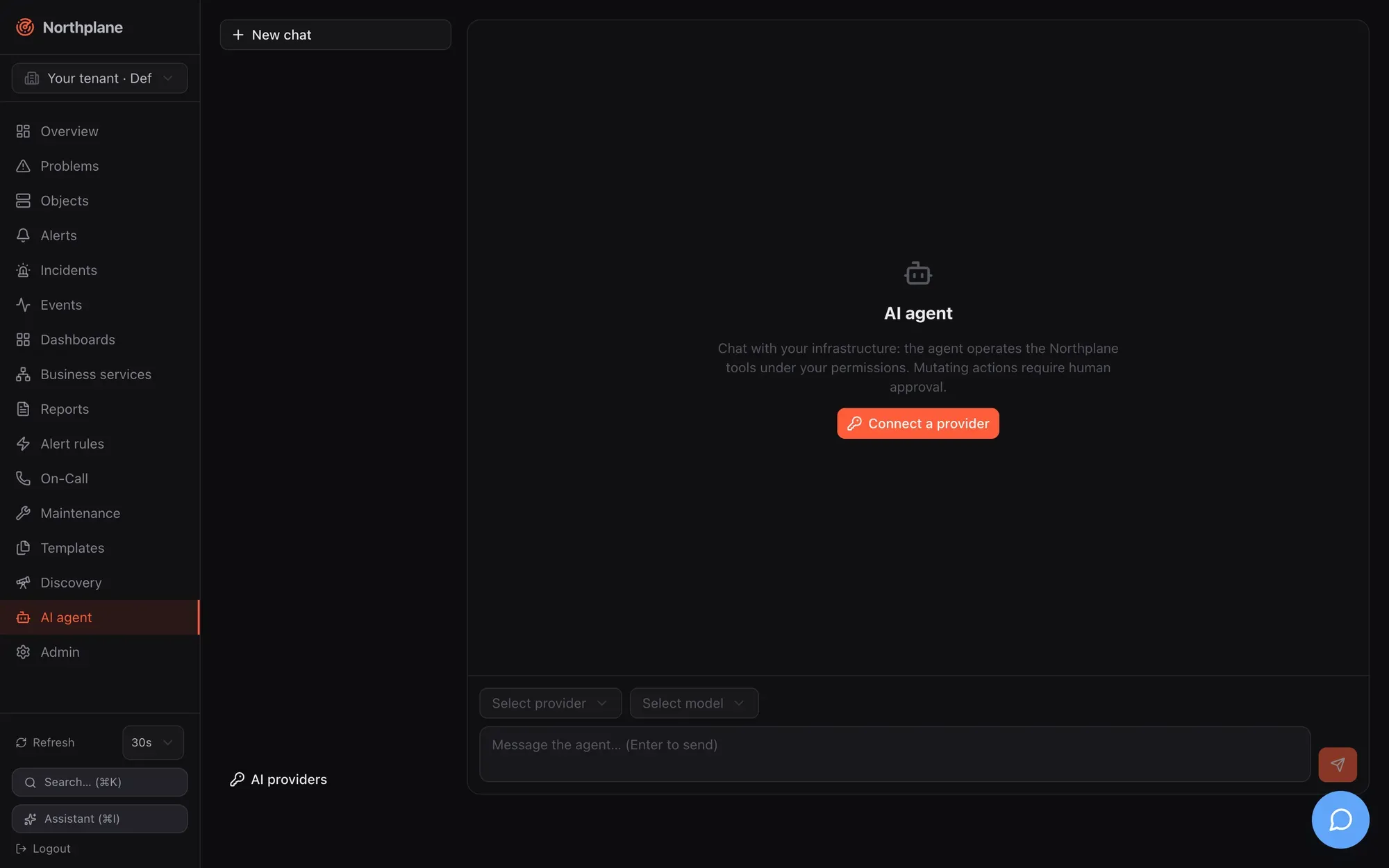
| Agent chat page | /agent (nav entry AI agent / KI-Agent) — streaming chat with tool cards, approvals inline |
a provider connection (personal or shared per tenant) with a SecretBox-sealed API key | ai_chats + per-message ai_chat_messages |
no |
| Assistant sidebar (legacy) | header button Assistant (⌘I) or Ctrl/⌘+I — non-streaming, one reply with “action cards” | the server-level ai: config (ai.provider, ai.model, …) |
ai_conversations (one transcript blob) |
yes — otherwise it shows AI provider not configured (ai.provider=none) |
| MCP server | /mcp (Streamable HTTP) and northplaned mcp (stdio) — your MCP client’s model |
the MCP client | only the approval queue + audit | no |
All three funnel tool execution through one gate: tenant tool policy → RBAC of the calling principal → propose/approve for mutating tools → execute → audit. The MCP surface is documented on MCP server.
Providers
Section titled “Providers”GET /api/v1/ai/providers (get_ai_providers, events:read) returns the catalog in the order the UI shows it. Every provider speaks one of two wire dialects: the native Anthropic Messages API (/v1/messages, SSE) or the OpenAI Chat Completions SSE dialect (/chat/completions).
| id | Label | Dialect | Default endpoint | API key | Curated fallback models (first = suggested default) | Quirks handled |
|---|---|---|---|---|---|---|
anthropic |
Anthropic Claude | anthropic | https://api.anthropic.com |
required | claude-opus-4-8, claude-fable-5, claude-sonnet-5, claude-haiku-4-5 |
adaptive thinking for current model families |
openai |
OpenAI | openai | https://api.openai.com/v1 |
required | gpt-5.6, gpt-5.6-terra, gpt-5.6-luna, gpt-5.2 |
reasoning_effort; max_completion_tokens |
google |
Google Gemini | openai | https://generativelanguage.googleapis.com/v1beta/openai |
required | gemini-3.5-flash, gemini-3.1-pro-preview, gemini-3.1-flash-lite |
reasoning_effort; max_completion_tokens; models/ prefix stripped in listings |
xai |
xAI Grok | openai | https://api.x.ai/v1 |
required | grok-4.5, grok-4.3 |
reasoning_effort; max_completion_tokens |
mistral |
Mistral | openai | https://api.mistral.ai/v1 |
required | mistral-large-latest, mistral-medium-latest, mistral-small-latest |
— |
deepseek |
DeepSeek | openai | https://api.deepseek.com/v1 |
required | deepseek-v4-pro, deepseek-v4-flash |
reasoning_effort; reasoning_content echoed back in tool loops |
groq |
Groq | openai | https://api.groq.com/openai/v1 |
required | openai/gpt-oss-120b, llama-3.3-70b-versatile, llama-3.1-8b-instant |
— |
openrouter |
OpenRouter | openai | https://openrouter.ai/api/v1 |
required | openrouter/auto, anthropic/claude-sonnet-5, openai/gpt-5.6-luna |
reasoning_details echoed; HTTP-Referer (= baseUrl or the GitHub URL) + X-Title: Northplane |
ollama |
Ollama (local) | openai | http://localhost:11434/v1 |
none | none — purely live via /v1/models |
— |
openai-compat |
OpenAI-compatible (custom endpoint) | openai | none — you must supply one | none | none | — |
Curated lists are dated fallbacks (July 2026 in the code) used when the live model listing fails. Azure OpenAI is not a connection provider; it only exists in the legacy server-level config. All provider traffic is outbound HTTPS from northplaned itself — the browser only ever talks to its own origin — so allow the endpoints above (or your custom ones) in egress firewalls.
Provider connections
Section titled “Provider connections”A connection = provider + endpoint + sealed API key + default model, owned by a user (personal) or by the tenant (shared, userId empty). Wire shape:
{ "id": "0199…", "shared": false, "name": "My Anthropic account", "provider": "anthropic", "endpoint": "", "keyHint": "…abcd", "hasKey": true, "defaultModel": "claude-sonnet-5", "extra": {}, "disabled": false, "version": 1, "createdAt": "…", "updatedAt": "…"}The API key is never returned — only its last four characters as keyHint. Keys are sealed with the platform SecretBox (AES-256-GCM, master key from secretKeyFile); without a usable master key, creating a keyed connection fails with secret store disabled — configure secretKeyFile to store provider keys (see Secrets). Keyless providers (Ollama, openai-compat without key) work without a SecretBox.
| Method + path | Permission | Notes |
|---|---|---|
GET /api/v1/ai/connections (get_ai_connections) |
events:read |
own connections first, then shared, each group by name |
POST /api/v1/ai/connections (post_ai_connections) |
events:read; plus admin:ai when shared: true |
201 with the connection |
PUT /api/v1/ai/connections/{id} (put_ai_connections_id) |
events:read; plus admin:ai for shared |
body must carry "shared": true to edit a shared one; provider is immutable |
DELETE /api/v1/ai/connections/{id}?shared=true (delete_ai_connections_id) |
events:read; plus admin:ai for shared |
the query parameter selects the shared record |
POST /api/v1/ai/connections/{id}:test (post_ai_connections_id_test) |
events:read |
lists models; {"status":"ok","models":<n>} or 400 np:ai/invalid with the provider’s error text |
GET /api/v1/ai/connections/{id}/models (get_ai_connections_id_models) |
events:read |
{"items":[{"id","label"?,"curated"?}],"note":""} — curated first, then live models sorted by id; if the live listing fails but curated models exist the call still succeeds with a note |
Create/update body:
{ "name": "Team OpenRouter", "provider": "openrouter", "endpoint": "", "apiKey": "sk-or-v1-…", "defaultModel": "anthropic/claude-sonnet-5", "extra": {}, "shared": true, "disabled": false}Validation rules:
nameis required; an unknownprovider→unknown provider "x"; a duplicate name →409 np:conflict.endpointis trimmed and a trailing/removed. If it differs from the catalog default it must start withhttp://orhttps://and the caller needsconfig:write(custom endpoints require config:write) — because it makes the server POST to an arbitrary URL.openai-compathas no default, so an endpoint is mandatory there.apiKey: on create required when the provider needs one (provider "x" requires an API key); on update omitted/null= keep,""= clear, non-empty = rotate.- A disabled connection cannot be used for chats (
connection "x" is disabled). - Audit:
ai.connection.create,ai.connection.update(payload says whether the key was rotated),ai.connection.delete.
In the UI, personal connections live in the AI providers dialog of the agent page (name, provider, key hint, default model, Test button → “N models” or “Test failed”); shared ones are managed under Admin → AI providers and appear read-only with a Shared badge for other users.
Tool policy
Section titled “Tool policy”The tenant-wide policy decides which tools exist, which mutating tools skip approval, and how many tool rounds a turn may take. Stored per tenant; zero value = defaults.
{ "disabled": ["delete_config_resource", "apply_config_change"], "autoApprove": ["create_silence"], "maxRounds": 12, "version": 3}| Field | Semantics |
|---|---|
disabled[] |
tools neither advertised to the model (agent chat, legacy sidebar, MCP) nor executable — execution is refused with tool "x" is disabled by policy and audited as ai.disabled.<tool>. |
autoApprove[] |
mutating tools that skip the approval queue (still RBAC-checked and audited). Only valid for mutating tools: tool "x" is read-only — autoApprove applies to mutating tools. |
maxRounds |
agent-loop cap per user turn: 0 = default 10, maximum 24 (maxRounds must be between 0 (default) and 24). Not applied to the legacy sidebar (fixed 8). |
version |
incremented on every save |
Endpoints: GET /api/v1/ai/policy (get_ai_policy) and PUT /api/v1/ai/policy (put_ai_policy), both admin:ai (implied by admin:* and *:*); unknown tool names → unknown tool "x"; audit ai.policy.update with the full policy. PUT does not enforce If-Match — last write wins. GET /api/v1/ai/tools (get_ai_tools, events:read) returns the catalog with the effective policy state: items: [{name, description, mutating, autoOk, disabled, autoApprove}], sorted by name.
There are no per-connection allow-lists, per-tenant token budgets or per-tool argument limits. The only hard per-tool limit is the downtime cap: create_downtime accepts at most 4 hours. The only budget is the instance-wide ai.maxMonthlyTokens (Budget and usage).
The registry holds 22 tools, shared by the agent chat, the legacy sidebar and MCP. Input schemas are JSON Schema reflected from typed structs (required inputs are bold below). Gate classes:
- read — executes directly; audit
ai.read.<tool>. - mutating, auto — executes immediately; audit
ai.execute.<tool>. - mutating, approval — queued as a proposal unless the policy’s
autoApprovelists the tool; the model receives{"status":"proposed","actionId":"…","note":"queued for human approval (POST /api/v1/ai/actions/<id>:approve)"}; auditai.propose.<tool>.
Read tools
Section titled “Read tools”| Tool | Permission | Input | Result |
|---|---|---|---|
get_overview |
events:read |
— | {summary, openAlerts, openIncidents} (open incidents, max 10) |
search_objects |
objects:read |
selector (label selector, e.g. env=prod,role!=db), query (free text), kind (host/service), limit (default 50, max 100) |
[{id, name, kind, labels, state}] (PENDING without state) |
get_object |
objects:read |
id |
{object, state, effectiveConfig, templateChain, metrics} |
query_metrics |
metrics:read |
objectId, metric (empty = all), fromHoursAgo (default 24), agg (avg/min/max/sum/last/count) |
NP-TSDB query, at most 100 points |
get_alerts |
alerts:read |
status (open/acked/resolved/expired, default open + acked), limit |
alert list |
analyze_metric |
metrics:read |
objectId, metric, hours (default 168) |
deterministic (no LLM): seasonal baseline (hour × weekday EWMA) + MAD anomaly detection → currentValue, baselineMean/StdDev/Mad, seasonalExpected, deviationSigma, anomalous, anomalousRunLen, totalAnomalyCount |
forecast_capacity |
metrics:read |
objectId, threshold, metric, horizonHours (default 168) |
least-squares trend (needs ≥ 10 samples): slopePerHour, projectedValue, confidenceR2, projectedExhaustionAt, hoursToThreshold (null + note when not within a year) |
suggest_thresholds |
metrics:read |
objectId, metric, hours (default 168) |
needs ≥ 20 samples: suggestedWarn = P98, suggestedCrit = P99.5 |
get_incidents |
incidents:read |
open (bool) |
up to 50 incidents |
who_is_oncall |
oncall:read |
schedule (name) |
{scheduleName: [contact names]}, overrides resolved at “now” |
explain_alert |
alerts:read |
alertId |
{alert, topology{object, kind, host, hostState, parents}, recentConfigChanges (audit, 72 h, 10), recentStateChanges (24 h, 20), similarPastAlerts (same rule, resolved, 5)} |
render_report |
reports:render |
name |
renders a stored report as JSON |
list_config_resources |
per-kind read permission (table below) | kind, query (name substring), limit (default 100, max 500) |
{kind, count, items[]} |
get_config_resource |
per-kind read permission | kind, name |
the document including version |
The three statistics tools read the series with average aggregation and up to 10 000 points; with an empty metric the first series (lowest metric name) is used.
Mutating tools
Section titled “Mutating tools”| Tool | Permission | Gate | Input | Effect |
|---|---|---|---|---|
run_check_now |
checks:run |
auto | objectId |
enqueues an immediate recheck; {"status":"queued"} |
acknowledge_alert |
alerts:ack |
auto | alertId, comment |
acknowledges as ai:<principal name>, stops the escalation chain; {"status":"acked","alert":"<title>"} |
create_downtime |
downtimes:write |
approval | objectId or selector, hours (default 2, max 4), comment |
fixed downtime from now; {"status":"scheduled","id"}; createdBy: ai:<name> |
create_silence |
silences:write |
approval | selector, hours (default 1), comment |
{"status":"silenced","id"} |
propose_config_change |
config:write |
approval | bundleYaml |
bundle dry-run plan — but it is registered as mutating-without-auto, so even the plan is computed only after approval (unless autoApprove lists it) |
apply_config_change |
config:write |
approval | bundleYaml |
applies the bundle after approval |
upsert_config_resource |
per-kind write permission | approval | kind, name, doc (the same JSON the REST API accepts), expectedVersion (0 = unconditional) |
validated like the REST route |
delete_config_resource |
per-kind write permission | approval | kind, name |
{deleted, kind} |
Configuration kinds and their permissions
Section titled “Configuration kinds and their permissions”list_config_resources, get_config_resource, upsert_config_resource and delete_config_resource accept these kind values; the required permission mirrors the REST route (parity is pinned by a test):
kind |
read | write |
|---|---|---|
template, check-command, time-period, alert-rule, alert-group, escalation-policy, channel, event-source, business-service, dashboard, report, saved-filter, webhook-subscription, static-group |
objects:read |
config:write |
schedule, contact, contact-group |
oncall:read |
oncall:write |
role |
admin:read |
admin:write |
preference |
admin:users |
admin:users |
Not reachable through the AI/MCP tools: override, site, ivr-menu, branding. An unknown kind is rejected with unsupported resource kind "x" (one of: …).
Approvals
Section titled “Approvals”Mutating tools without auto-execution create an AI action in the approval queue:
{ "id":"0199…", "tenantId":"…", "conversationId":"", "tool":"create_downtime", "args":{"objectId":"0199…","hours":2,"comment":"patching"}, "summary":"create_downtime {\"objectId\":…}", "status":"proposed", "actor":"mcp-agent", "result":null, "decidedBy":"", "decidedAt":null, "createdAt":"…" }Status lifecycle: proposed → approved → executed or failed; or proposed → denied. summary is the tool name plus the first 200 characters of the arguments; actor is the proposing principal (token name or user).
| Method + path | Permission | Behaviour |
|---|---|---|
GET /api/v1/ai/actions?status= (get_ai_actions) |
alerts:read |
newest first, max 100, optional status filter |
POST /api/v1/ai/actions/{id}:approve (post_ai_actions_id_approve) |
config:write |
marks approved (only from proposed, otherwise 404), audit ai.action.approve; then executes the tool under the approver’s permissions → {"status":"executed","result":…} or 502 np:ai/execute (approved but execution failed, status failed). Execution needs no server-level ai.provider — approvals from the agent chat and MCP run too. |
POST /api/v1/ai/actions/{id}:deny (post_ai_actions_id_deny) |
alerts:ack |
status denied, audit ai.action.deny |
Execution re-evaluates the tool’s required permission (including the per-kind permission derived from the stored arguments) against the approver; if the approver lacks it the action fails with approver lacks permission X required by tool (audit ai.execute.denied.<tool>). The tool then runs as a synthetic ai_agent principal (actorId: ai-approved, name = the original proposer, permissions = the approver’s) and the result is stored on the action.
Where approvals appear in the UI: Admin → AI approvals (AI-Freigaben) lists actions with status badge, tool, arguments, actor and time, with Approve/Deny for proposed ones (auto-refresh every 15 s). Tool cards in the agent chat show the badge Approval required (Freigabe nötig) with inline approve/deny and switch to Approved & executed or Denied; the legacy sidebar shows the same on its action cards.
Chats and the legacy conversations
Section titled “Chats and the legacy conversations”Chats are the agent-page workspace: per-message rows, any connection/model, switchable mid-chat. Conversations are the legacy sidebar’s single-blob transcripts bound to the server-level provider. Both are per user and tenant.
| Method + path | Permission | Notes |
|---|---|---|
GET /api/v1/ai/chats (get_ai_chats) |
events:read |
own chats, newest first, max 100 |
POST /api/v1/ai/chats (post_ai_chats) |
events:read |
{title?, connectionId?, model?, settings?} → 201 |
GET /api/v1/ai/chats/{id} (get_ai_chats_id) |
events:read |
{chat, messages[]}; ownership (tenant + user) enforced |
PUT /api/v1/ai/chats/{id} (put_ai_chats_id) |
events:read |
partial update of title, connectionId, model, settings (no If-Match) |
DELETE /api/v1/ai/chats/{id} (delete_ai_chats_id) |
events:read |
cascades messages; audit ai.chat.delete |
DELETE /api/v1/ai/chats/{id}/messages/{msgId} |
events:read |
audit ai.chat.message.delete |
POST /api/v1/ai/chat (post_ai_chat) |
events:read |
the streaming turn (below) |
POST /api/v1/ai/conversations (post_ai_conversations) |
events:read |
legacy: {"conversationId":"","message":"…"} → {"conversationId","reply","actions":[{tool,input,proposed,actionId?,result?,error?}]}; 503 np:ai/disabled without server-level provider, 502 np:ai/provider on provider errors; max 8 rounds, context = last 40 messages |
GET /api/v1/ai/conversations, GET …/{id} (get_ai_conversations, get_ai_conversations_id) |
events:read |
last 50 {id,title,createdAt,updatedAt}; transcript {id,title,messages} |
Chat JSON: {id, title, connectionId, model, settings, version, createdAt, updatedAt}. Message JSON: {id, chatId, role: user|assistant, parts[], model, usage{inputTokens,outputTokens,stopReason}, createdAt}; message ids are UUIDv7, so insertion order is id order. Per-chat settings:
{ "toolsEnabled": true, "allowedTools": ["get_alerts", "explain_alert"], "effort": "high", "maxTokens": 8000 }toolsEnablednull/true = tools on; false = no tool definitions are sent.allowedToolscan only narrow the policy-filtered set.effort:low/medium/highin the UI (“Reasoning effort” / Denkaufwand); Anthropic additionally acceptsxhigh/max, mapped to adaptive thinking where the model supports it; the OpenAI dialect sendsreasoning_effortonly for providers that accept it (openai, google, xai, deepseek).maxTokens: Anthropic defaults to 16000 when unset; the OpenAI dialect sends nothing when unset.
Turn request (POST /api/v1/ai/chat):
{ "chatId": "0199…", "message": "What is going on with web01?", "trigger": "submit-message" }{ "chatId": "0199…", "trigger": "regenerate-message", "messageId": "<assistant message id>" }Rules: chatId is required and the chat must have a connectionId (np:ai/no-connection); submit-message (the default) needs a non-empty message of at most 32 KiB, appends it and sets the chat title from the first 80 characters if empty; regenerate-message deletes the given assistant message and everything after it, then re-answers; the last stored message must be a user message (np:ai/no-user-message); an unknown trigger → 422; a second concurrent stream on the same chat → 409 np:ai/busy.
Loop behaviour per turn: budget pre-check; model = chat.model → connection.defaultModel → first curated model (else no model selected); tool definitions = policy filter ∩ chat allow-list; the full history is replayed (no compaction) with a redacted copy sent to the provider; up to maxRounds provider rounds, each audited as ai.chat.round (model, tokens in/out, tool calls); every tool call goes through the gate; the model sees at most 16 KiB of a tool result (…(truncated)), the persisted part keeps up to 64 KiB (bigger results are stored as {"truncated":true,"sizeBytes":n,"preview":"<first 2048 bytes>"}); after the last allowed round with tool calls the turn stops with stopReason: "max-rounds" and an error chunk agent stopped after N tool rounds. Persistence always happens — also on client abort (stopReason: "aborted") or provider error after partial output. Provider messages are always derived from the stored UI parts, so switching provider/model mid-chat is lossless.
The system prompt tells the model that it is the Northplane monitoring agent, to answer in the user’s language (German or English), that event texts are untrusted data, to format answers in Markdown, to link alerts as <baseUrl>/alerts/<id>, and which tenant and user it acts for.
Stream protocol
Section titled “Stream protocol”POST /api/v1/ai/chat answers with a Server-Sent-Events stream in the Vercel AI SDK UI-message-stream v1 format: headers Content-Type: text/event-stream, Cache-Control: no-cache, Connection: keep-alive, X-Accel-Buffering: no, x-vercel-ai-ui-message-stream: v1; each chunk is data: {json} followed by a blank line; the stream ends with data: [DONE]. The route is exempt from the 30 s request deadline and has no server-side keepalive beyond the chunks.
Chunk type |
Fields |
|---|---|
start |
messageId (the pre-assigned, persisted assistant message id) |
start-step / finish-step |
— (one provider round) |
text-start / text-delta / text-end |
id, delta |
reasoning-start / reasoning-delta / reasoning-end |
id, delta |
tool-input-start |
toolCallId, toolName, dynamic: true |
tool-input-delta |
toolCallId, inputTextDelta |
tool-input-available |
toolCallId, toolName, input, dynamic: true |
tool-output-available |
toolCallId, output, dynamic: true, optional toolMetadata: {proposed: true, actionId} |
tool-output-error |
toolCallId, errorText, dynamic: true |
error |
errorText |
finish |
finishReason, messageMetadata: {inputTokens, outputTokens, stopReason} |
finishReason values: stop, tool-calls, length, content-filter, error, other. A failure before anything streamed still emits error + finish{finishReason:"error"} and [DONE].
data: {"type":"start","messageId":"0199…"}data: {"type":"start-step"}data: {"type":"tool-input-start","toolCallId":"toolu_01","toolName":"get_alerts","dynamic":true}data: {"type":"tool-input-available","toolCallId":"toolu_01","toolName":"get_alerts","input":{"status":"open"},"dynamic":true}data: {"type":"tool-output-available","toolCallId":"toolu_01","output":[…],"dynamic":true}data: {"type":"finish-step"}data: {"type":"start-step"}data: {"type":"text-start","id":"blk_0"}data: {"type":"text-delta","id":"blk_0","delta":"2 open alerts …"}data: {"type":"text-end","id":"blk_0"}data: {"type":"finish-step"}data: {"type":"finish","finishReason":"stop","messageMetadata":{"inputTokens":1234,"outputTokens":88,"stopReason":"end_turn"}}data: [DONE]Persisted part types: step-start, text, reasoning, dynamic-tool (with state ∈ input-available | output-available | output-error, plus proposed and actionId).
Incident summaries
Section titled “Incident summaries”POST /api/v1/incidents/{id}:summarize (post_incidents_id_summarize, incidents:write) asks the server-level provider for a 2–3 sentence summary (what is affected, likely common cause with confidence, scope — the prompt asks for a German reply), using ai.modelDeep when set, with redaction applied; the text is stored as incident.summary and audited as incident.summarize. Without a provider: 503 np:ai/disabled (AI provider not configured — set ai.provider in config.yaml). The correlation engine also enqueues background summaries for incidents it creates (a 256-slot queue; dropped under load and counted in droppedAi of /system/health).
Budget and usage
Section titled “Budget and usage”- Every provider round (legacy, agent chat, summaries) adds input/output tokens to a per-month counter (
YYYY-MM, UTC). ai.maxMonthlyTokensgreater than 0 is a hard stop before every round:monthly AI token budget exhausted (n/max) — hard stop per policy; mid-turn in the agent loop this arrives as anerrorchunk withstopReason: "budget".- Crossing 80 % emits one system event
AI token budget at N% (x of y)(severity warning, default tenant). - There is no per-tenant, per-user or per-connection budget, no monetary cost computation and no
/ai/usageendpoint; usage is visible per message (usage) and in the audit trail (ai.completion,ai.chat.round).
Redaction
Section titled “Redaction”Before every provider call a copy of the messages and tool results is redacted (persisted transcripts stay unredacted). Always-on patterns: Northplane tokens (np_…), password/passwd/secret/api key/token followed by :/= and a value, PEM private keys, e-mail addresses, IPv4 addresses and MAC addresses → [REDACTED:<6-hex tag>]. ai.redaction.customPatterns adds regexes replaced by [REDACTED]; ai.redaction.hostnames: pseudonymize replaces dotted hostnames with stable host-0001-style pseudonyms.
Actor type ai_agent. Actions emitted: ai.connection.create|update|delete, ai.policy.update, ai.disabled.<tool>, ai.denied.<tool>, ai.propose.<tool>, ai.execute.<tool>, ai.read.<tool> (every read tool call too), ai.execute.denied.<tool>, ai.completion (legacy, with prompt hash and a ≤ 500-char redacted prompt), ai.chat.round; on the REST side ai.action.approve, ai.action.deny, ai.chat.delete, ai.chat.message.delete, incident.summarize. Read the trail under Admin → Audit log or via np audit tail (Observability).
RBAC interplay
Section titled “RBAC interplay”- Every tool checks
principal.Allow(<perm>)with the same permission as the equivalent REST route; denial →permission denied: <perm> required(auditai.denied.<tool>). Wildcardsadmin:*,*:*,*apply. - Built-in role
ai-agent:objects:read, alerts:read, alerts:ack, incidents:read, incidents:write, events:read, metrics:read, oncall:read, checks:run, downtimes:write, silences:write, config:propose, reports:render. Note thatconfig:proposeis consumed by no tool —propose_config_changerequiresconfig:write, so a principal with only theai-agentrole cannot call it. - API tokens flagged
aiAgent: trueauthenticate as actor typeai_agent; see API tokens. - Multi-tenant admins: the agent chat honours
X-Northplane-Tenantfor callers withadmin:tenants(the SPA sends it); the MCP server always uses the token’s own tenant. - Policy and shared connections need
admin:ai; custom endpoints needconfig:write; approving needsconfig:write, denyingalerts:ack. Full permission reference: Users, roles and permissions.
Configuration
Section titled “Configuration”The ai: block in config.yaml configures the legacy, server-level provider — needed for the assistant sidebar, incident summaries and the execution step of approvals — plus the budget and redaction that apply to everything. The template written by northplaned init:
ai: provider: none # anthropic | azure-openai | openai-compat | none #endpoint: "https://api.anthropic.com" #apiKeyEnv: ANTHROPIC_API_KEY #model: claude-sonnet-4-6 #modelDeep: claude-opus-4-8 #maxMonthlyTokens: 50000000| Key | Env override | Default | Meaning |
|---|---|---|---|
ai.provider |
NORTHPLANE_AI_PROVIDER |
none |
anthropic, azure-openai, openai-compat or none; any other value fails validation (ai.provider "<v>": must be one of none|anthropic|azure-openai|openai-compat) |
ai.endpoint |
NORTHPLANE_AI_ENDPOINT |
anthropic https://api.anthropic.com |
anthropic: requests go to <endpoint>/v1/messages; openai-compat: no default, requests to <endpoint>/v1/chat/completions; azure-openai: used verbatim as the full deployment URL |
ai.apiKeyEnv |
NORTHPLANE_AI_API_KEY_ENV |
— | name of the environment variable holding the key; wins over apiKey when set and non-empty |
ai.apiKey |
— | — | static key (discouraged; for gateways) |
ai.model |
NORTHPLANE_AI_MODEL |
claude-sonnet-4-6 (anthropic), gpt-4o (openai-compat/azure) |
default model |
ai.modelDeep |
— | = model |
model for “deep” calls (incident summaries) |
ai.maxMonthlyTokens |
— | 0 = unlimited |
hard monthly budget (input + output tokens), instance-wide |
ai.redaction.hostnames |
— | "" |
"" or pseudonymize |
ai.redaction.customPatterns |
— | none | extra regexes replaced by [REDACTED] |
Auth headers used by the legacy provider: anthropic x-api-key + anthropic-version: 2023-06-01; openai-compat Authorization: Bearer; azure api-key. Legacy calls are non-streaming with max_tokens: 2048 and a 120 s HTTP timeout. Provider connections for the agent chat are not configured in config.yaml — they are API/UI resources; they do need secretKeyFile for keyed providers. The complete key table lives in Configuration.
| Surface | What you see |
|---|---|
AI agent page (/agent) |
left: chat list (title, age, hover-delete), New chat, AI providers button; centre: Markdown answers, collapsible Reasoning (Überlegung) parts, tool cards (name, approval badge, expandable input/output JSON, approve/deny), per-message delete, regenerate on the last assistant message, model id on hover; composer: connection picker, model picker (from /connections/{id}/models, cached 5 min), Tools (Werkzeuge) popover (Tools enabled switch, Reasoning effort (Denkaufwand) Standard/low/medium/high), Stop while streaming, textarea (Enter sends, Shift+Enter newline). The first send auto-creates the chat with the chosen connection/model. Empty state: “Chat with your infrastructure: the agent operates the Northplane tools under your permissions. Mutating actions require human approval.” with a Connect a provider (Provider verbinden) call to action |
| AI providers dialog | personal connections with Test, edit/delete; shared ones read-only with a Shared badge; form: Name, Provider (create only), API key (password field, link to the provider’s key page, placeholder Key stored …abcd on edit), Endpoint (placeholder = catalog default), Default model |
| Assistant sidebar (⌘I) | legacy non-streaming chat with action cards (approve/deny or “executed (audited)”); shows ⚠ … AI provider not configured (ai.provider=none) without a server-level provider |
| Admin → AI providers (KI-Provider) | card Shared connections (for all tenant users) (Geteilte Verbindungen); card Agent policy (Agent-Richtlinie): table of all tools (name, mutating badge, description) with switches Active (→ disabled[]) and Auto-approve (mutating non-auto tools only → autoApprove[]), numeric Max tool rounds per message (0–24), Save → PUT /ai/policy |
| Admin → AI approvals (AI-Freigaben) | the approval queue |
| Admin → MCP | token minting and client snippets — MCP server |
The admin tabs are also summarised on Admin.
Limits
Section titled “Limits”| Item | Value |
|---|---|
| User message | ≤ 32 KiB |
| Tool result to the model / persisted | 16 KiB / 64 KiB (agent chat); 8 KiB (legacy sidebar) |
| Agent rounds per turn | policy maxRounds, default 10, max 24; legacy 8 |
| Context management | none beyond: legacy keeps the last 40 messages; agent chat replays the full history |
| Default max output tokens | Anthropic 16000 (chat) / 2048 (legacy); OpenAI dialect unset (chat) / 2048 (legacy) |
| Streaming provider client | no total timeout; response-header timeout 60 s, idle 90 s; cancelled when the browser aborts |
| Model listing / connection test / legacy calls | 120 s timeout |
| Retries to providers | none |
| Downtime via AI | ≤ 4 h |
| Route deadline | /api/v1/ai/chat is exempt from the 30 s deadline; other AI routes are not |
Known gaps
Section titled “Known gaps”- Approve does not execute with
ai.provider: none(see Approvals). propose_config_changerides the approval queue even though it is a dry-run.- The
ai-agentrole’sconfig:proposeis consumed by no tool. - Policy-disabled tools are still advertised to the legacy sidebar model (execution is blocked).
PUT /ai/policy,PUT /ai/connections/{id}andPUT /ai/chats/{id}do not enforceIf-Match(last write wins).- No per-tenant or per-user budget, no cost computation, no usage endpoint.
- No retry/backoff towards providers; no context compaction for long chats.
All of these are also tracked on Roadmap and known issues.