
Voice calls and IVR
Northplane is a phone-capable alarm server in both directions. People can call in to raise, list, acknowledge or resolve alarms through a configurable IVR menu, and Northplane calls out to whoever is on call, reads the alarm and takes an acknowledgement by keypad. Both directions work with a cloud carrier (Twilio) or entirely on premises with your own Asterisk/FreePBX and SIP trunks — no cloud in the call path. The same IVR menu resources drive both stacks.
| Twilio (cloud) | Asterisk / FreePBX (on-prem) | |
|---|---|---|
| Inbound calls | event source voice-inbound; Twilio posts webhooks to /api/v1/voice/inbound/…, Northplane answers with TwiML |
event source asterisk-inbound; the dialplan hands the call to Northplane’s FastAGI listener (port 4573) |
| Outbound calls | voice channel, provider: twilio — TTS + <Gather> |
voice channel, provider: asterisk — AMI Originate into your dialplan |
| Speech | a TTS profile (<Play> of Northplane-synthesized clips) or Twilio TTS (language, optional voice) |
a TTS profile (STREAM FILE / NP_AUDIO_URL), your TTS app (ttsApp, e.g. Flite, eSpeak, a piper wrapper) or pre-recorded np-* prompt files |
| Keypad ack on outbound calls | 4 = acknowledge, 6 = resolve via the signed gather callback |
the dialplan posts to the same callback (NP_ACK_URL) |
| Inbound SMS | event source sms-inbound (Twilio messaging webhook) |
— |
Channel configuration keys are listed on Notification channels; the generic event-source fields (authMode, secretRef, rateLimit, labels) are on Event sources; all acknowledgement paths side by side are on Acknowledge and snooze. How the spoken text is produced — engines, voices, language detection, pronunciation rules — is on Text-to-speech; this page describes the call flows.
IVR menus
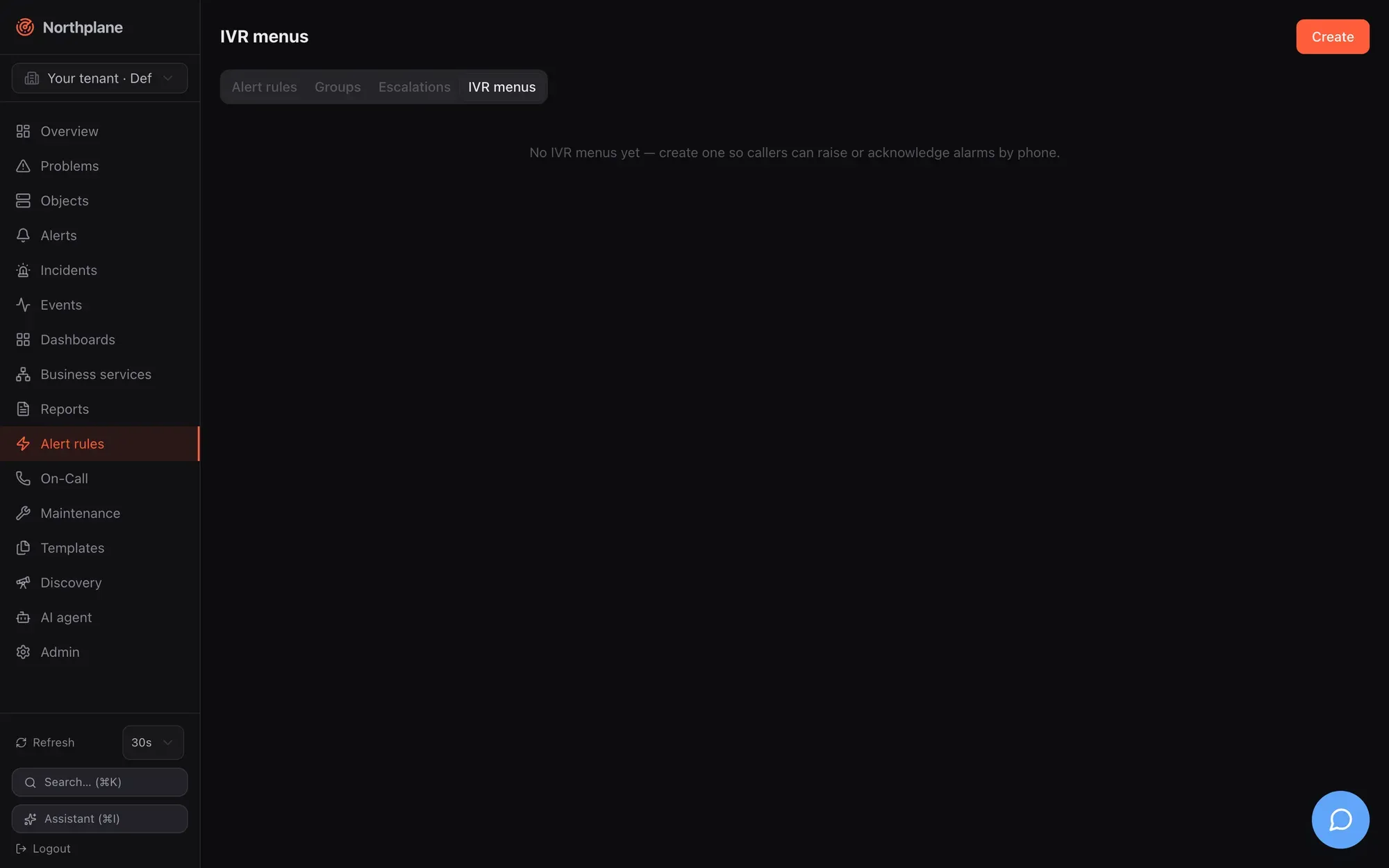
Section titled “IVR menus”An IVR menu is a resource of kind ivr-menu (bundle kind IVRMenu), edited under Alerting → IVR menus (IVR-Menüs) or at /api/v1/ivr-menus (objects:read / config:write). A voice-inbound or asterisk-inbound source references a menu by name in its menu config key; without one (or when the named menu does not exist — a warning is logged) the built-in menu is used: 1 = raise an alarm and record a message (severity critical), 2 = list open alarms, 3 = acknowledge.
| Field | Notes |
|---|---|
language |
TTS language tag, e.g. de-DE; wins over the source’s language. Prompts are German for any de*, English otherwise (both stacks) |
voice |
Twilio <Say voice> name, e.g. Polly.Vicki; wins over the source’s voice; ignored by Asterisk |
greeting |
spoken first; default Welcome to the Northplane alarm line. / Willkommen bei der Northplane Alarmzentrale. |
pin |
DTMF gate; callers must enter exactly these digits before the menu |
trustCallerId |
true lets callers whose number matches a contact’s phone skip the PIN |
options[] |
the menu entries, see below |
Options:
| Field | Notes |
|---|---|
digit |
0–9, * or # |
action |
trigger-alarm, list-alerts, ack-alert, resolve-alert or say |
label |
announcement text; announced as "<label>: <digit>". Without a label the default phrase is used (To raise an alarm, press 1. …). A say option without a label is not announced on Twilio |
severity |
trigger-alarm: default critical (or the source’s severity) |
title |
trigger-alarm: alert title; {caller} and {called} expand; default Phone alarm from {caller} |
labels |
trigger-alarm: extra alert labels, e.g. np.sound: np_klaxon for the alarm app (see Mobile push) — they win over the source’s labels |
escalationPolicy |
trigger-alarm: policy for this option; falls back to the source’s escalationPolicy |
record |
trigger-alarm: true records a voice message after the alarm is raised |
text |
say: what to speak (Twilio and Asterisk TTS mode) — in Asterisk prompt-file mode it names a sound file to play |
kind: IVRMenumetadata: { name: alarm-menu }spec: language: de-DE voice: Polly.Vicki greeting: "Leitstelle Nordwerk." pin: "4711" trustCallerId: true options: - { digit: "1", action: trigger-alarm, severity: critical, title: "Telefonalarm von {caller}", escalationPolicy: call-alarm, record: true, labels: { np.sound: np_klaxon }, label: "Alarm" } - { digit: "2", action: list-alerts } - { digit: "3", action: ack-alert } - { digit: "4", action: resolve-alert } - { digit: "5", action: say, text: "Bereitschaft diese Woche: Team Blau." }What the actions do (identical semantics on both stacks unless noted):
- trigger-alarm raises a manual alert (
ruleId: manual) with the option’s severity/title/labels and starts the escalation policy. Manual alarms bypass downtimes, silences and flapping suppression. The caller is recorded as the actor — the contact’s name if the caller id matches a contact’sphone(digits compared), otherwise the number. Dedup key:call/<CallSid>(Twilio) oragi/<uniqueid>(Asterisk), so a provider retry of the same call does not open a second alert. - list-alerts reads the newest five open alerts (
1: critical. Title. 2: …) and returns to the menu. - ack-alert / resolve-alert: no open alarms → “There are no open alarms.” and hang up; exactly one → acted on immediately; several → “Choose the alarm with the digit keys. 1: … 2: …” and one digit selects. Acknowledging stops the escalation chain; resolving also resolves a rule-created incident when it was the last alert. Both are audited (
alert.ack/alert.resolvewithvia: voice-inboundorasterisk-agi). - say speaks the text and returns to the menu.
Inbound alarm line
Section titled “Inbound alarm line”One voice-inbound event source per phone number (or Twilio SIP domain). Create it under Admin → Event sources (Event-Quellen) with type voice-inbound, or in a bundle:
kind: EventSourcemetadata: { name: alarm-line }spec: type: voice-inbound enabled: true authMode: token secretRef: alarm-line-token # a stored secret: the webhook token config: menu: alarm-menu language: de-DE allowFrom: "+49,+43" escalationPolicy: call-alarm severity: critical twilioAuthToken: $SECRET:twilio-auth$| Key | Default | Notes |
|---|---|---|
menu |
built-in | IVR menu name |
language |
en-US |
TTS language when the menu has none |
voice |
— | Twilio <Say voice>, e.g. Polly.Vicki; the menu’s voice wins |
ttsProfile |
default (if it exists) |
TTS profile: prompts are synthesized by Northplane and <Play>ed instead of <Say>d |
allowFrom |
all callers | comma-separated E.164 prefixes (+49,+43); only digits and + are compared; anything else → 403 np:ingress/caller |
escalationPolicy |
— | default policy for alarms raised from the menu |
severity |
critical |
default for trigger-alarm options without a severity |
twilioAuthToken |
— | $SECRET:name$ or literal; when set, X-Twilio-Signature is verified on every webhook |
Then point the number’s Voice webhook (HTTP POST) in the Twilio console at
https://monitoring.example.net/api/v1/voice/inbound/<source-id>?token=<secret>The source’s id and the ?token= form are shown in the Admin → Event sources table and dialog; the source name works in the path as well. authMode: token compares ?token=<secret> (or Authorization: Bearer) with the stored secret named by secretRef; Twilio re-posts every follow-up action URL verbatim, and Northplane puts the token into those URLs, so the whole call is authenticated. hmac, basic and none are accepted too — see Event sources.
Signature check. With twilioAuthToken set, Northplane recomputes Twilio’s signature (HMAC-SHA1 over the public URL plus the sorted form parameters) and rejects mismatches with 401 np:ingress/auth. The public URL is built from the config key baseUrl (path and query appended) — set baseUrl to exactly the origin Twilio calls, otherwise every signature fails.
Call flow. Each step is a TwiML <Gather input="dtmf" timeout="10"> around the spoken texts:
- If the menu has a
pinand the caller is not trusted: greeting + “Please enter your PIN.” —len(pin)digits, one try; wrong → “Wrong PIN. Goodbye.” and<Hangup/>. - Main menu: greeting (not repeated after a PIN) + one announcement per option; one digit; unknown digit → “Invalid input.” and the menu again; no input → “Goodbye.”
- The chosen action runs as described under IVR menus. After
trigger-alarmwithrecord: truethe caller hears “Speak your message after the tone, finish with the pound key.” and Twilio records up to 120 s (<Record maxLength="120" finishOnKey="#" playBeep="true" transcribe="true">); the recording callback adds the labelrecordingUrl(<RecordingUrl>.mp3, hosted by Twilio) to the alert, the transcription callback addstranscript(truncated to 500 characters). Withoutrecordthe call ends after “The alarm has been raised. Notifications are on their way.”
Alert labels for Twilio-raised alarms: caller, called, callSid, then the source’s labels, then the option’s labels (later wins); the alert payload carries via: voice. The source’s rateLimit/burst (default 50/s, 200) apply per webhook.
One asterisk-inbound event source per alarm line. Northplane runs a FastAGI listener; the PBX terminates the SIP trunks and the dialplan hands the answered call over with a single line. The whole conversation (PIN, menu, recording, ack/resolve) is driven by Northplane over AGI — no cloud, no webhooks.
kind: EventSourcemetadata: { name: pbx-line }spec: type: asterisk-inbound enabled: true config: listen: "tcp://:4573" menu: alarm-menu language: de-DE ttsApp: Flite # empty = prompt-file mode escalationPolicy: call-alarm severity: critical allowFrom: "+43,0" recordDir: /var/spool/asterisk/recording| Key | Default | Notes |
|---|---|---|
listen |
tcp://:4573 |
FastAGI bind address (tcp:// prefix optional). One listener per distinct address across all tenants; several sources may share one address |
menu |
built-in | IVR menu name |
language |
en |
phrase language in TTS mode (de* → German); the menu’s language wins |
ttsApp |
— | Asterisk application that speaks its argument (EXEC <ttsApp> "<text>"), e.g. Flite, ESpeak, or a Gosub/AGI wrapper around piper. Empty = prompt-file mode |
ttsProfile |
default (if it exists) |
TTS profile: prompts are synthesized by Northplane and played with STREAM FILE — from ttsDir or over a signed URL (res_http_media_cache); ttsApp / prompt files remain the fallback |
ttsDir / ttsDirPBX |
— | directory shared with the PBX for the synthesized clips, and the same directory as the PBX sees it |
escalationPolicy |
— | default policy |
severity |
critical |
default severity |
allowFrom |
all | comma-separated caller-id prefixes (digits/+ compared); denied callers see VERBOSE "northplane: caller not allowed" and are dropped |
recordDir |
/var/spool/asterisk/recording |
directory on the PBX for recordings |
Dialplan (extensions.conf / FreePBX custom context), with the source id or name as the AGI URL path:
[alarm-line]exten => s,1,AGI(agi://northplane.example.internal:4573/pbx-line) same => n,Hangup()Point the trunk’s inbound route (DID) at the alarm-line context. Routing rules: the AGI path must equal a source’s id or name; an empty path is accepted only when the listener serves exactly one source; otherwise the call is dropped with VERBOSE "northplane: unknown alarm line". Several lines = several sources, distinguished by the path (they can share the listener). The listener accepts at most 32 concurrent calls, ends a session after 10 minutes and is reconciled every 30 s after source changes. If Northplane runs in a container, publish port 4573/tcp (the standard Compose files do not) — see Deployment overview.
Conversation. ANSWER; caller id = agi_callerid, called number = agi_dnid. PIN gate (GET DATA, 8 s, three tries; trusted contact numbers skip it); greeting; up to five menu rounds: options are announced with barge-in (a digit pressed during a prompt is taken), then WAIT FOR DIGIT 7 s; no input → goodbye and hang up. trigger-alarm speaks “The alarm has been raised…”, then with record: true records RECORD FILE <recordDir>/np-<alertId> wav "#" 120000 BEEP and adds the label recordingFile=<recordDir>/np-<alertId>.wav — the audio stays on the PBX. list-alerts speaks the index (SAY NUMBER) and severity; titles are spoken only in TTS mode. ack-alert/resolve-alert with several open alarms wait 8 s for the choice. Alert labels: caller, via=asterisk, then source labels, then option labels; payload via: asterisk-agi; dedup key agi/<agi_uniqueid>.
Speech output — three modes.
- a TTS profile applies (
ttsProfile, or a profile nameddefault): every prompt, option and alert title is synthesized by Northplane — with language detection and pronunciation rules — and streamed to the caller; see Text-to-speech. The two modes below are the fallback when no clip can be produced. ttsAppset: every prompt, option and alert title is spoken dynamically through that application. Any app that takes the text as its argument works (Flite,ESpeak, or a smallGosub/AGIwrapper that renders piper to a temp file and plays it).ttsAppempty: Northplane plays pre-recorded prompt files from the Asterisk sounds directory (e.g./var/lib/asterisk/sounds/) and says digits withSAY NUMBER; alert titles are skipped. Record or generate these 20 files once (any format Asterisk can play, e.g. 8 kHz mono.wavor.sln16):
np-greeting np-pin np-pin-bad np-invalid np-byenp-alarm-raised np-record-now np-recorded np-no-alertsnp-ack-confirm np-resolve-confirm np-list-intronp-opt-trigger np-opt-list np-opt-ack np-opt-resolve np-choosenp-sev-critical np-sev-warning np-sev-infoThe np-opt-* files are the phrase up to the digit (“To raise an alarm, press”) — Northplane appends the digit with SAY NUMBER. np-pin is played by GET DATA as the PIN prompt. A say option’s text names a further sound file in this mode. Example with piper (then convert to 8 kHz mono for Asterisk):
echo "Willkommen bei der Northplane Alarmzentrale." \ | piper --model de_DE-thorsten-medium.onnx --output_file np-greeting-22k.wavsox np-greeting-22k.wav -r 8000 -c 1 /var/lib/asterisk/sounds/np-greeting.wavOutbound calls
Section titled “Outbound calls”Outbound calls are notifications through a voice channel. The spoken text is the channel template (default Northplane alert. Severity CRITICAL. <title>. Press 4 to acknowledge, 6 to resolve.) or, when the alert carries the label np.tts, exactly that label’s value — set it per rule with setLabels, per IVR option, or in the manual trigger. The called number is the contact’s phone. With a TTS profile (channel key ttsProfile, label np.ttsProfile, or a profile named default) the text is synthesized by Northplane and the providers play the clip — Twilio <Play>, Asterisk NP_AUDIO_URL / NP_AUDIO_FILE, generic {audioUrl}; otherwise the providers speak as described below.
kind: Channelmetadata: { name: alarm-voice }spec: type: voice enabled: true config: provider: twilio accountSid: ACxxxxxxxxxxxxxxxxxxxxxxxxxxxxxxxx apiKeySid: SKxxxxxxxxxxxxxxxxxxxxxxxxxxxxxxxx apiKeySecret: $SECRET:twilio-api-secret$ from: "+15551234567" language: de-DENorthplane places the call with inline TwiML:
<Response> <Gather numDigits="1" timeout="10" action="https://…/api/v1/voice/gather/<token>" method="POST"> <Say language="de-DE" loop="2">TEXT</Say> </Gather> <Say language="de-DE">No input received. Goodbye.</Say></Response>The text is read twice; one keypress ends the prompt. Without a gather URL (test sends, or no baseUrl/ack secret) the call only speaks the text. language defaults to en-US; a voice key is not used for outbound calls. With a TTS profile the <Say loop="2"> becomes <Play loop="2"> of the synthesized clip and the closing phrase follows the detected language. Credentials: accountSid plus either authToken or (preferred) apiKeySid + apiKeySecret; from is the caller id; apiBase overrides the API host. The provider id is the Twilio call sid.
kind: Channelmetadata: { name: pbx-voice }spec: type: voice enabled: true config: provider: asterisk host: pbx.example.internal port: "5038" username: northplane secret: $SECRET:ami-secret$ channel: "PJSIP/{to}@trunk" context: northplane-alert exten: s priority: "1" callerId: "Northplane <8000>" timeoutMs: "30000"Northplane logs in to the Asterisk Manager Interface (Events: off) and sends Originate with Async: true: Channel = the template with {to} replaced by the contact’s phone, Context/Exten/Priority (or Application/Data when application is set), CallerID, Timeout, and the channel variables
| Variable | Value |
|---|---|
NP_TEXT |
the spoken text (CR/LF removed, at most 1024 characters) |
NP_SEVERITY |
CRITICAL, WARNING, INFO or OK |
NP_ACK_URL |
the signed gather callback (only for real alerts and with baseUrl set) |
NP_AUDIO_URL, NP_AUDIO_FILE, NP_LANG, NP_TEXT_SPOKEN |
with a TTS profile: the synthesized clip as signed URL and/or file in ttsDir, its language and the normalised text — see Text-to-speech for a dialplan that plays them |
Your dialplan owns speech and keypad handling. A minimal context that speaks the text with Flite, takes one digit and reports 4/6 back through the callback (adapt the TTS application and paths to your PBX):
[northplane-alert]exten => s,1,Answer() same => n,Wait(1) same => n,Flite(${NP_TEXT}) same => n,Read(DIGIT,,1,,1,10) same => n,GotoIf($["${NP_ACK_URL}" = ""]?bye) same => n,GotoIf($["${DIGIT}" = "4"]?ack) same => n,GotoIf($["${DIGIT}" = "6"]?resolve) same => n(bye),Hangup() same => n(ack),System(curl -s -X POST "${NP_ACK_URL}" -d Digits=4) same => n,Hangup() same => n(resolve),System(curl -s -X POST "${NP_ACK_URL}" -d Digits=6) same => n,Hangup()The AMI manager user (manager.conf) needs write = originate. TLS: tls: "on" connects with TLS 1.2+ (Asterisk tlsenable=yes, usually port 5039), insecure: "true" skips certificate verification. Timeouts: 10 s dial, 20 s overall; a rejected originate fails the delivery with originate rejected: <message> and is retried by the outbox.
Any HTTP voice gateway: url with {to} and {text} placeholders (GET, query-escaped) or jsonBody (POST JSON with the placeholders replaced unescaped), optional username/password basic auth. No keypad acknowledgement is possible on this path. With an empty provider and no accountSid, a voice channel behaves as generic-http.
Acknowledging by keypad
Section titled “Acknowledging by keypad”POST /api/v1/voice/gather/{token} is the callback both outbound stacks use. The token is the same signed, 24-hour token as the ack link (<alertId>.<contactId>.<expiry>.<hmac>), so no login is needed; it is only generated when baseUrl is configured. Form field Digits:
| Digit | Effect | Condition |
|---|---|---|
4 |
acknowledge the alert, stop the escalation chain | alert is open |
6 |
resolve the alert, stop the chain, resolve a rule-created incident if it was the last alert | alert is open or acked |
| anything else | TwiML <Say>Not acknowledged. Goodbye.</Say> |
Invalid or expired token → “This acknowledgement link is invalid or expired. Goodbye.” The actor is the contact name (or id) from the token; the audit entry is alert.ack / alert.resolve with {"via":"voice-dtmf"}. Responses are English TwiML regardless of the channel language. Twilio posts Digits itself; from an Asterisk dialplan curl -X POST "$NP_ACK_URL" -d Digits=4 does the same.
Inbound SMS
Section titled “Inbound SMS”A sms-inbound event source turns a Twilio number’s Messaging webhook into alarms and acknowledgements. URL: https://<host>/api/v1/sms/inbound/<source-id>?token=<secret> — auth, allowFrom, twilioAuthToken, rate limit and the ?token= rule are exactly as for voice.
kind: EventSourcemetadata: { name: sms-line }spec: type: sms-inbound enabled: true authMode: token secretRef: sms-line-token config: { action: alert, escalationPolicy: sms-alarm, ackKeyword: OK, language: de }| Key | Default | Notes |
|---|---|---|
action |
event |
event publishes a normalised ingress event through the alert rules (rules decide, full CEL matching); alert raises an alert directly |
escalationPolicy |
— | policy for action: alert |
severity |
warning |
invalid values fall back to warning |
ackKeyword |
ACK |
case-insensitive prefix match on the message body |
language |
en |
de* → German replies |
allowFrom, twilioAuthToken |
as for voice |
Behaviour per incoming message (form fields From, To, Body, MessageSid):
- Body starts with the keyword: the sender must match a contact’s
phone(replyUnknown number — not acknowledged.otherwise). Northplane acknowledges the newest open alert of the tenant (not a specific one), stops its chain, auditsalert.ackwithvia: smsand repliesAcknowledged: <title>(German:Quittiert: <title>); with no open alarm:No open alarms. - Otherwise the body becomes the summary (empty →
SMS alarm from <from>; truncated at 200 characters).action: alert→ manual alert with labelsfrom,to+ source labels, dedup keysms/<MessageSid>, payloadvia: sms, chain started withescalationPolicy.action: event→ingressevent withlabels {from, to}+ source labels andpayload {body, from, to}— match it in a rule, e.g.event.source == "<source-id>" && event.payload.body.contains("FIRE")(see Alert rules). Reply:Alarm received./Alarm angenommen.; metricnp_ingress_events_total{type="sms"}.
Checklist
Section titled “Checklist”baseUrl(NORTHPLANE_BASE_URL) is set to the public origin — needed for ack links, the gather callback, Twilio signature verification and theactionURLs of inbound calls.- The event source is
enabled: true(disabled sources answer403 np:ingress/disabled) and itssecretRefnames an existing secret (token auth rejects everything otherwise). - Callers who should acknowledge or skip the PIN exist as contacts with their number in
phone. - Exactly one
voicechannel is enabled per tenant — only the alphabetically first enabled one is used (selection rule). - Verify deliveries and inbound actions in the Events page:
notificationevents per call attempt,alert_opened/ackevents per phone action; failed calls after all retries appear under Admin → Dead letters (Reliability).